
NHS Health Checks:
Automated

Automating NHS Health Checks
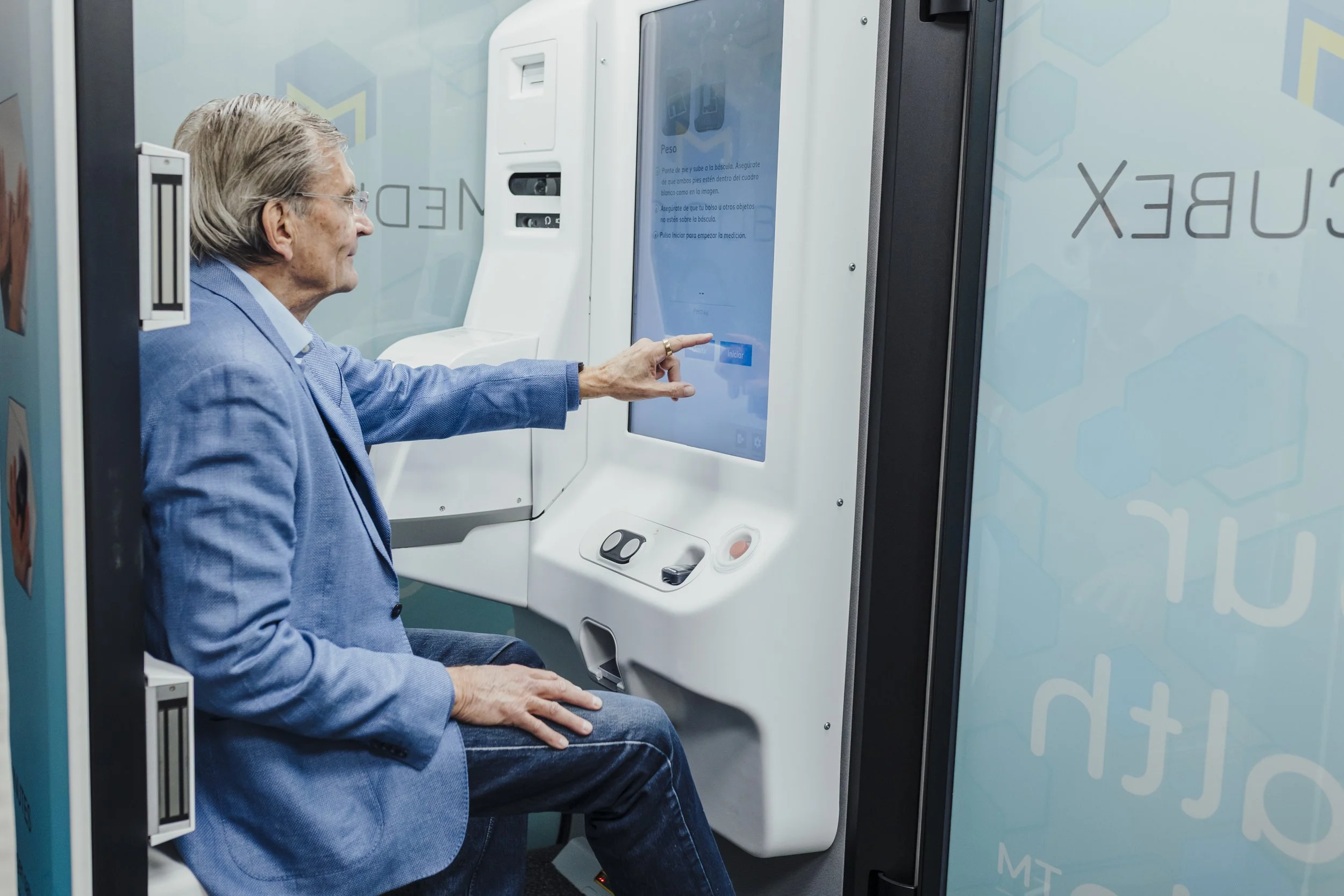
Traditional screening can be time-consuming for both patients and providers. The MedicubeX eHealth Station™ is a clinical-grade solution designed to support the NHS mission of early detection and CVD prevention.
Fast: Complete screening in under five minutes.
Non-Invasive: Accurate results without the discomfort.
Unassisted: Frees up medical staff while providing patients with immediate insights.
By focusing on the four pillars of heart health, diet, activity, tobacco cessation, and biometric awareness, individuals can stay ahead of the 32% statistic.
Because 80% of CVD is preventable, and prevention starts with a check.
eHealth Station™ is used by leading experts in the UK, Germany, Finland, and the Baltics
SDHC
Universitätsklinikum Frankfurt
Helsinki
Terveystalo
Universitätsklinikum Schleswig-Holstein
Istekki
SDHC Universitätsklinikum Frankfurt Helsinki Terveystalo Universitätsklinikum Schleswig-Holstein Istekki





The MedicubeX eHealth Station™ is a portable, self-service hub that provides users with a fast and comprehensive health assessment in just a few minutes.
In addition, it does cardiovascular and diabetes risk assessment with the help of AI-powered diagnostic tools.
After the measurements, the results can be automatically sent to a healthcare provider to be reviewed.
Scalable Solution for automating NHS Health Checks
Accessible. Accurate. Automated.
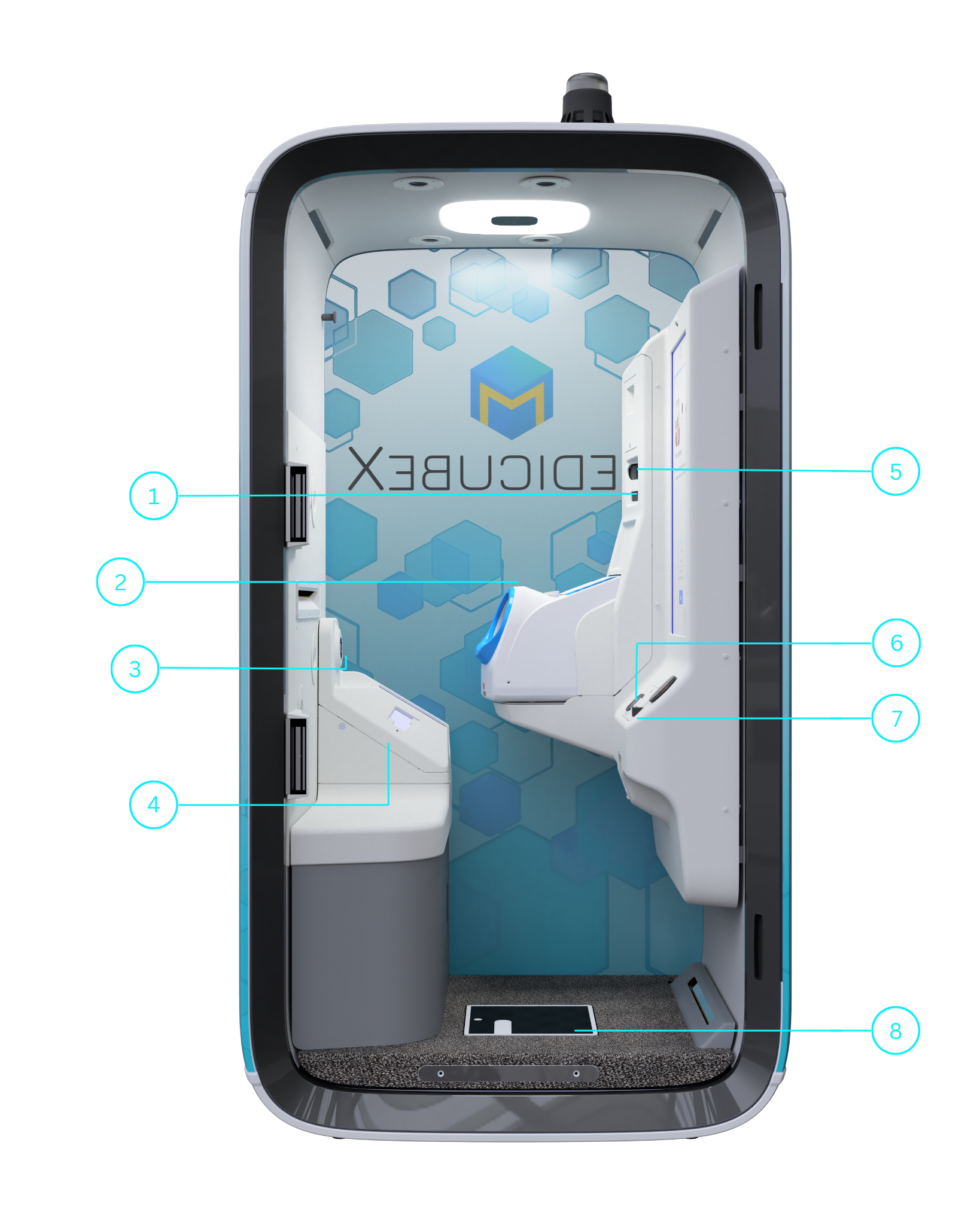

eHealth Station™
an MDR Article 22 Medical System
Body temperature
Blood pressure, Pulse rate
Body fat, Basal metabolic rate
AGE Reader: Risk of CVD and T2D
Respiratory rate
ECG: HRV, HR, Rhythm analysis, Arrhythmia detection
Oxygen saturation (SpO2)
Weight
Heart auscultation, valve defect detection in 2026
List of measurements
The MedicubeX eHealth Station™ is an MDR Article 22 Medical System
MedicubeX MHRA Reference Number is 35132
The eHealth Station™’s GMDN® Code is 57960
Basic UDI-DI 64298302262EHLTHSTATION2P
Dr. Al-Shamaa explains why he thinks eHealth Station™ is the perfect solution for digitizing health checks.


NHS Health Check: The dilemma and the goal
The Capacity Challenge of NHS Health Check: Why We Need a New Solution
The NHS Health Check is a vital prevention programme, but meeting the demand for the millions of eligible adults aged 40–74 is a monumental task for primary care. To effectively tackle cardiovascular disease (CVD) and type-2 diabetes, the NHS must reach a massive percentage of the population every year.
That is a challenge traditional clinical settings are struggling to meet. During period 2025/26 Q3, only 1.8% of total eligible population received NHS Health Checks.
Even with the rollout of the Digital NHS Health Check, the sheer volume of physical screenings required (blood pressure, BMI, and heart rhythm) is staggering.
When we look at the manual resources required to conduct a standard NHS Health Check, the bottleneck becomes clear:
20-30 minutes: The time it takes a healthcare professional to screen one person (BP measurement + weight + height + lifestyle survey).
2-3 screenings: The maximum number one professional can conduct per hour.
3,220-4830 people: The total number of screenings one full-time healthcare professional can perform annually (working 7h/day, 5 days/week, 46 weeks/year).
26,000+ people: The annual screening capacity of one MedicubeX eHealth Station™, after which a healthcare professional needs to look over the results and decide the next steps.
To hit national targets using traditional methods, the UK would need thousands of full-time healthcare professionals dedicated solely to perform NHS Health Checks. eHealth Station™ automates the non-invasive measurement part, allowing clinicians to focus on analysing outcomes and high-risk interventions instead of routine data collection.
Furthermore, the eHealth Station™ is compliant with privacy and GDPR regulations in healthcare.
Who is the NHS Health Check for?
The check is designed for adults aged 40 to 74 who are not already managing a vascular condition. It is your "Midlife MOT" if you do not have any of the following:
Heart disease or heart failure
Chronic kidney disease or Type-2 diabetes
High blood pressure (hypertension) or Atrial fibrillation
Stroke or Transient ischaemic attack (TIA)
Peripheral arterial disease or Inherited high cholesterol
Current prescriptions for statins
A previously calculated CVD risk of 20% or higher
NHS Health Check Flow
Save the healthcare professionals’ time for interpreting results instead of performing vital sign measurements.
Patients can access the eHealth Station™ in publicly accessible locations to receive a comprehensive non-invasive NHS Health Check and CVD risk profile in just 5 minutes.
Practical Example of NHS Health Check Process
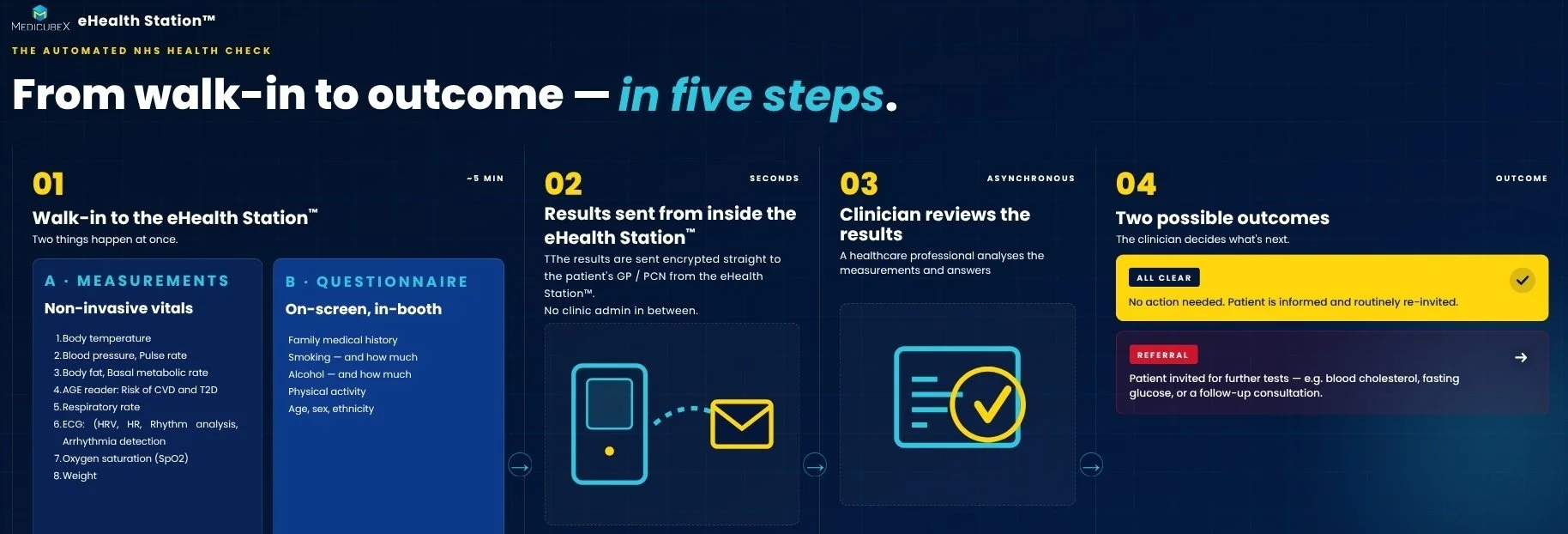
1. Autonomous health check
Person takes non-invasive measurements in the eHealth Station™
Answers questions related to health and lifestyle
2. Results sent to healthcare professional
All the measurements and answers can be sent to a healthcare provider to be assessed straight from the eHealth Station™
3. Healthcare professional goes over the results
Clinician reviews the results and decides on what will happen next
4. Two outcomes: All clear or Referral
Once the clinician has reviewed the results, the patient is either re-invited to do the same process in the next planned timeframe or they are referred to book an in-person consultation or directed to a lab for blood tests.
The Strategic Value of Automating Health Checks for the NHS
Preventing cardiovascular disease isn't just a clinical goal; it is a fundamental pillar of the NHS Long Term Plan.
By shifting from reactive treatment to proactive screening, we can transform patient outcomes and system sustainability.
✅ Reducing Premature Mortality: With 80% of cardiovascular disease being preventable, widespread screening is the most effective way to meet the NHS goal of preventing 150,000 heart attacks, strokes, and dementia cases. Early detection directly reduces mortality rates across the community.
✅ Easing the Financial Burden on the NHS: Early intervention is significantly more cost-effective than emergency secondary care. By identifying risks like hypertension and AFib at the "Midlife MOT" stage, the long-term costs associated with hospital admissions, complex surgeries, and long-term stroke rehabilitation are reduced.
✅ Optimising Primary Care Capacity: High-quality, automated data allows for faster, more accurate clinical decision-making. By using the MedicubeX eHealth Station™ to capture clinical-grade vitals unassisted, GP surgeries can focus their limited resources on high-risk patients who require immediate intervention rather than routine data collection.
✅ Driving Patient-Centered Care & Self-Management: In line with the NHS ‘Personalised Care’ model, our station empowers individuals to "know their numbers" and take ownership of their health. This direct engagement fosters long-term lifestyle changes and improves adherence to preventative pathways, such as the Four Pillars of heart health.

“We believe that the MedicubeX solution is truly groundbreaking and it has all the potential to become a world leading self-measurement station and non-invasive screening tool for cardiovascular diseases and type 2 diabetes.
Cardiovascular diseases are the leading cause of death worldwide. Still there is no solution for easy prevention and screening. MedicubeX has the potential to fill this huge void.”
Univ.-Prof. Dr. med. David M. Leistner,
Director of Cardiology and Angiology
Frankfurt University Hospital


MedicubeX is rethinking NHS Health Checks by making non-invasive 5-minute health screenings accessible for everyone.

More on eHealth Station™ ECG
eHealth Station™ takes a 1-lead ECG from everyone and use AI technology to analyze the rhythm.
The ECG can instantly detect more than 20 different arrhythmias and calculate ECG intervals and complex durations.


-
Normal sinus rhythm
Sinus tachycardia
Sinus bradycardia
Sinus arrhythmia
Pause
-
First-degree atrioventricular block with normal sinus rhythm
First-degree atrioventricular block with sinus bradycardia
First-degree atrioventricular block with sinus tachycardia
-
Premature ventricular contraction
Ventricular couplet
Ventricular triplet
Ventricular bigeminy
Ventricular trigeminy
Ventricular tachycardia
Slow ventricular tachycardia
-
Premature supraventricular contraction
Atrial couplet
Atrial run
Atrial bigeminy
Atrial trigeminy
Atrial fibrillation
Atrial flutter
Supraventricular tachycardia
-
Interventricular conduction delay
Normal sinus rhythm with interventricular conduction delay
Sinus bradycardia with interventricular conduction delay
Sinus tachycardia with interventricular conduction delay


AI Predictive Tools
We are developing cardiovascular disease risk analysis algorithms and AI which will help identify the individuals’ CVD risks and enable timely intervention. Proactive treatment can increase the healthy working years of life and improve life quality
The development is being made together with VTT Technical Research Center of Finland.


Why are these measurements important for CVD Prevention?

-
Helps in the assessment of: strokes, heart attacks, vertigo etc.
-
Helps in the assessment of: arrhythmias, heart attacks, pulmonary embolisms, pneumonia etc.
-
Helps in the assessment of: COPD, pulmonary embolisms, pneumonia, asthma etc.
-
Helps in the assessment of: COPD, pulmonary embolisms, pneumonia, asthma etc.
-
Overweight and obesity → increases the risk of developing conditions such as type 2 diabetes, cardiovascular diseases, sleep apnea, osteoarthritis, and certain cancers.
Underweight → can indicate malnutrition, eating disorders, chronic diseases (e.g., cancer, lung diseases), hyperthyroidism, or other metabolic disorders.
Rapid weight changes → can indicate changes in fluid balance, for example, from conditions such as heart failure, kidney failure, or liver diseases.
Weight monitoring → helps to assess the effectiveness of lifestyle interventions, medication, or treatment programs (e.g., for patients with diabetes or heart conditions).
-
Helps in the assessment of: arrhythmias, such as atrial fibrillation, long QT, AV-blocks, screening of changes in ECG (Q-wave, U-wave, Bundle branch block, AV-Block) etc.
-
Helps in the assessment of: risk of strokes or heart attacks, risk of type 2 diabetes and it’s complications
-
This helps to assess the risk of type 2 diabetes and its complications, as well as the need for lifestyle interventions. The Basal Metabolic Rate (BMR) is used to evaluate the balance between energy intake and expenditure, which is essential for planning effective weight management and lifestyle strategies.